



GATE isn’t just an isekai with helicopters and dragons. It’s also an anime that quietly asks a modern, uncomfortable question: what happens when a democratic state tries to stay “state-like” under constant scrutiny—laws, cameras, politics, and all—while operating in a place that doesn’t naturally fit its legal assumptions?
This is an anime analysis article based on GATE: Jieitai Kanochi nite, Kaku Tatakaeri(GATE 自衛隊 彼の地にて、斯く戦えり). We’re reading the show like a political thriller wearing fantasy armor. The focus here is not “how to do violence.” It’s how rule-bound institutions absorb pressure, and how that pressure can drain the feeling of victory even when the battlefield looks one-sided.
The lens is a stress test. Imagine the JSDF’s conduct inside a gravity field that behaves like Rules of Engagement: discrimination, proportionality, accountability, and public justification. Not as a sterile checklist, but as a force that reshapes every decision.
GATE keeps circling a twist that many action shows avoid. The JSDF’s hardware is impressive, but the fragile part is legitimacy. Legitimacy is a resource. It can be earned. It can also be spent, leaked, or burned. And in a world that never stops watching, it burns fast.
The episodes we’re modeling: 8–10 and the earth-side pressure
GATE has plenty of action, but Episodes 8–10 are the clearest “rules + optics + politics” cluster. They’re strong anchors for a serious anime case study because they show the JSDF being judged not only by outcomes, but by process.
Episode 8: “Japan, Beyond the Gate” does something quietly ruthless. It pulls the mission back into the Japanese political bloodstream. The JSDF isn’t framed as a wandering hero party. It’s framed as a state institution whose legitimacy can be questioned, reduced, or revoked. The visitors from the Special Region aren’t just guests; they are living evidence. They turn governance into a stage play: Japan must perform “being Japan” in front of cameras, lawmakers, and a public that wants reassurance, not complexity.
That’s the episode’s hidden weapon. It teaches you that the mission is not only fought in the Special Region. It is fought in Tokyo, through budget lines, committee questions, headlines, and the public’s tolerance for ambiguity. The Diet hearing atmosphere isn’t “politics interrupting the plot.” It is the plot.
Episode 9: “The Hakone Mountain Night Battle” compresses a protection mission into a trap where competence is necessary but never sufficient. The setting matters: a place that feels domestic, familiar, “safe.” That familiarity increases the political stakes. If something goes wrong here, it doesn’t feel like a distant expedition problem. It feels like a failure at home.
Episode 10 then makes the aftershock feel modern. The conflict doesn’t end when the immediate danger ends. It continues as narrative turbulence: competing interpretations, faster-than-facts commentary, and institutional decisions that are shaped as much by optics as by operational logic.
We’ll use these episodes as anchors, not cages. This isn’t a recap. It’s a frame for reading GATE’s underlying engine: Japan’s power looks overwhelming, yet the show keeps hinting that power isn’t the bottleneck. Governance is.
Not a comfort read: the anime sells pleasure, and we have to admit it
Let’s say the quiet part out loud. Parts of GATE are designed to feel good. The show offers the relief of asymmetry: modern equipment and coordination dominating a world that can’t match it. That pleasure matters. It shapes how viewers interpret “restraint” and “force,” and it mirrors a political danger: when strength feels enjoyable, procedure starts looking like weakness and caution starts looking like cowardice.
This article refuses the easy comfort of “strong equals right.” It also refuses the cynical comfort of “rules are fake.” GATE becomes interesting when it accidentally reveals that both strength and restraint can be real, and both can carry a cost.
That cost isn’t only strategic. It’s emotional. National pride, humiliation, revenge impulses, the need to feel safe, the hunger for decisive endings—these are not side notes. They are variables that can bend policy until the policy breaks.
ROE as gravity: the hidden price of staying disciplined
People say “Rules of Engagement” and imagine a list of permissions. In practice, ROE-like constraints behave like gravity. They don’t dictate every move. They reshape the shape of every move.
In a GATE-like environment, the “rule weight” usually comes from three overlapping expectations.
Discrimination and proportionality. You must distinguish threats from non-threats and match force to the situation. That sounds clean until you remember the setting: mixed populations, cultural misunderstandings, fear, opportunists, and the constant temptation for others to weaponize your caution.
Accountability. It’s not enough to act. You must be able to explain why you acted. That creates a bureaucratic shadow: documentation, recording, review, approvals, public statements, parliamentary briefings, interagency coordination.
Legitimacy. Your authority to keep operating is conditional. It is renewed, day by day, through public trust, parliamentary tolerance, and diplomatic management. Legitimacy is a resource, and it can be spent faster than it can be earned.
Paradox: the more rule-bound you are, the more you must avoid mistakes. But avoiding mistakes often means slower decisions, narrower options, and heavier process. Meanwhile, other actors may not share that burden. They can move faster precisely because they don’t need to justify themselves to anyone you can vote out.
Accountability starts at home: the Diet hearing effect
Episode 8 matters because it shows the mission’s real battlefield: not only the Special Region, but Japan’s domestic legitimacy system.
In a conventional action narrative, success is victory: defeat the enemy, secure the area, rescue the people. In a rule-heavy state operation, success also includes “did you stay within lawful authority?” and “can elected leaders survive supporting this?” Those questions are not distractions. They are constraints. They can end missions even when the mission is tactically working.
Episode 8’s deeper implication is uglier: accountability is not only about truth. It’s about timing. A legislature doesn’t just ask, “What happened?” It asks, “Why did you let it happen?” and “Why should we keep paying for a mission that produces more questions than confidence?”
That’s why the visitors matter. They are a narrative bridge. They make Japan look humane and reasonable to domestic audiences. But the bridge is fragile. The moment the mission produces an incident that feels unjustifiable, the same bridge becomes a stage where the state is accused of hypocrisy.
Think of the operation as a three-layer loop. The field produces events. The institution produces records. Politics produces permission. If politics withdraws permission, the other layers don’t matter.
The no-win minute: when rules don’t rescue you
Most clean analyses avoid the moment where rules don’t save you. GATE hints at that moment, especially around the pressure-cooker episodes, and we need to stare at it without flinching.
One minute. That’s all it takes for the mission to stop being “operations” and become “politics.”
A partner runs toward the checkpoint, yelling that someone is being dragged away nearby. A second later, another voice screams that the runner is a decoy. Your interpreter freezes—half terrified, half furious—because the partner is someone they personally vouched for.
If you move, you might leave your own people exposed and look reckless on camera. If you don’t, you might be the reason an ally disappears—and your restraint turns into a quiet betrayal.
The worst part is that the rules don’t solve the pain. The rules only define what you must justify later.
And later arrives fast. A shaky clip hits social media. Commentators call it cowardice. Others call it discipline. Politicians smell blood. Foreign embassies draft statements. The truth is still incomplete, but the story is already complete.
In that minute, “being careful” doesn’t feel like virtue. It feels like choosing which kind of guilt you can live with.
The opportunity cost people avoid naming
Rule-bound caution has a price beyond tempo. The harshest price is moral: the lives you might have saved if you could act faster and harder. This is the ethical grenade that tidy frameworks avoid, because it ruins the comfort of “restraint is always the higher ground.”
Sometimes restraint prevents unnecessary harm. Sometimes restraint delays action until it’s too late for someone who trusted you. In a mixed environment, the line between those outcomes is not a philosophical debate. It’s a clock.
Here is the personal truth that the anime forces on you if you stop watching it as a victory reel: restraint isn’t weakness. But restraint becomes cruelty when it’s used to avoid choosing. If rules become a hiding place, the institution is still responsible for the harm created by delay.
GATE is not trying to be a tragedy, but it contains tragedy’s seed: an institution that wants to be lawful can still become complicit in harm through hesitation, paralysis, and the fear of scandal.
Hakone sells pleasure, and pleasure changes politics
Episode 9 is a masterclass in compressed risk. It’s also a reminder that the viewer is not neutral. The episode’s tension works because the audience feels the sweetness of competence under threat.
Let’s be honest about what the Hakone sequence sells: pleasure. Not strategy—pleasure. The clean competence, the asymmetry, the relief of “our side” being stronger. That feeling is part of the show’s engine, and it matters because pleasure dulls the appetite for accountability.
When power feels good, restraint starts looking like weakness. Procedure starts looking like a brake. Once a public mood shifts toward “just end it,” a rule-heavy institution becomes politically lonely. It can be attacked from both sides: accused of brutality when it acts, and accused of incompetence when it hesitates.
And Episode 9’s hidden implication is this: protection missions don’t only protect people. They protect symbols. If the protected figure becomes a symbol of national pride, then any restraint that slows protection can be framed as betrayal. If the protected figure becomes a symbol of political controversy, then any force used to protect them can be framed as authoritarianism. Either way, the mission is pulled into narrative warfare.
Narratives move faster than verification
Episode 10 reflects a modern reality: the internet does not wait for your facts.
Rule-heavy systems produce truth through process. You verify identities. You confirm timelines. You build records that survive cross-examination. That is good governance.
But the public experiences events through speed. People see fragments and form conclusions. Domestic political entrepreneurs attach themselves to whatever narrative is hottest. Foreign actors push framing. If your institution is slow because it’s trying to be accurate, “accurate but late” can be interpreted as evasive.
Here’s the non-rational variable that breaks “perfect architecture” fantasies: leaders do not always optimize for mission success. They optimize for survival. And once an audience tribe forms around a narrative, facts can become optional.
The answer isn’t propaganda. It’s operational honesty at speed: stable first truths that don’t overreach, combined with visible conduct patterns that reduce guesswork when the next clip goes viral.
A second no-win question, this time for the reader
You don’t get to stay comfortable if you’re treating this as a real case study. So here’s a second no-win question—one that hits the viewer’s moral posture, not only the institution’s.
If your friend is on the ground screaming for help, and the only options you can see in the moment are “move now and risk making everything worse” or “wait and risk losing them,” which guilt do you choose? And after you choose, will you still defend your choice when someone edits your worst ten seconds into a viral clip?
That’s the cruelty of operating under permanent observation. Your decision is judged twice: once by its outcome, and once by its screenshot. GATE’s post-Hakone mood swings make this feel visceral. The show doesn’t need a lecture to communicate it. It communicates it through whiplash.
The missing architecture: lawful coercion beyond emergency moments
This is the sharpest edge of the stress test. It’s not only about when you can use force. It’s about what you can do when you choose not to.
In real stability environments, the daily grind is detention, search, investigation, and protection of local partners. Those are the tools that keep you from relying on lethal action as your only lever.
But in a setting like the Special Region—neither clearly “Japan” nor clearly a normal foreign jurisdiction—authority becomes ambiguous. Ambiguity is not neutral. It creates a vacuum. Vacuums get filled by improvisation, and improvisation looks like arbitrariness under a camera lens.
The danger is a forced binary. If you lack lawful middle options, you drift toward extremes: do nothing because action is indefensible, or escalate because it’s the only way to stop immediate harm. Neither extreme is sustainable. Both generate legitimacy costs.
So the real question isn’t “can the JSDF be disciplined?” It’s “can the government provide a mandate that makes discipline workable?” Without that architecture, even good-faith restraint turns brittle.
The paper-trail burden: armor that weighs you down
Once accountability becomes mission-critical, the record becomes armor. Records protect institutions from lies, misunderstandings, and opportunistic framing. But armor weighs something.
The weight shows up as time, manpower, and cognitive load. Field units spend more effort documenting. Commanders spend more effort anticipating political questions. Lawyers and policy staff become part of operational tempo.
Here’s where the “mud” lives. A commander isn’t only thinking, “What keeps my people safe?” They’re also thinking, “What survives the hearing?” A minister isn’t only thinking, “What is right?” They’re thinking, “What won’t end my career in three days?” An interpreter isn’t only translating words. They’re translating trust—and trust can die in a rumor.
When you admit that, the anime’s politics stops feeling like filler. It starts feeling like the true environment the JSDF is trapped inside.
Pressure accumulates: how the mission gets heavier over time
To keep this grounded without becoming a playbook, model the pressure as accumulation. Even if individual incidents are manageable, the mission can become politically heavy because costs stack.
| Phase | Institutional posture | Public mood | Legitimacy risk shape |
| D+0 to D+14 | Establish control, signal discipline, build routines | Curiosity, novelty, early trust | Low but volatile; one incident can define the brand |
| D+15 to D+45 | Patterns emerge; standards tighten; messaging stabilizes | Polarization begins; “for/against” camps form | Scandal curve accelerates; opponents test narratives |
| D+46 to D+90 | Oversight load rises; flexibility narrows; caution hardens | Fatigue; impatience with complexity | Legitimacy becomes expensive; small errors become big politics |
Notice what shifts: not only threats, but interpretation. Once camps form, facts stop being shared ground. The mission becomes a symbol. Symbols are easier to attack than realities.
The scandal curve and the human sabotage inside the system
The scandal curve is the gap between how fast an incident becomes public belief and how slow a complex institution can produce verified explanation.
A cascade is common. First a clip spreads. Then a framing spreads. Then political actors attach themselves to the framing. Then foreign actors amplify it. Then the institution releases a cautious statement. Finally, the cautious statement is treated as guilt, weakness, or cover-up.
Here’s the mud that breaks “clean” models. Reality isn’t only chaotic. It is humiliatingly human. The discipline of a hundred drills can be shattered by one soldier’s private grudge, or one second of fear that arrives before training does. And when that happens, a single irreversible moment can move history faster than any stack of reports ever could.
Now add the darker mirror. We like to believe we want “the truth.” Most of the time, we want a story that protects our identity. If the public desires “the JSDF must be evil,” then accurate disclosure becomes noise. If the public desires “the JSDF must be invincible,” then nuance becomes betrayal. Even perfect transparency can be rejected simply because it refuses to satisfy the audience’s appetite.
So here’s the accusation the reader can’t dodge: are you actually here to understand what governance under observation does to human beings, or are you consuming “logical analysis” as entertainment—feeling thoughtful while staying safe?
That is why restraint can rot. Restraint stops being a principled choice and becomes a defensive posture designed to avoid blame. And when restraint becomes avoidance, it starts producing the very harm it claims to prevent.
Decision gates and the final shove
In rule-heavy democratic systems, missions rarely end because of a single tactical loss. They end because legitimacy costs converge until the mission becomes politically unpayable.
| Decision gate | What triggers it | Why it spikes legitimacy costs | Likely political move |
| Civilian harm the public can’t absorb | Accidental or contested harm near the operation | Even lawful acts can look incompetent or cruel | Hearings, restrictions, talk of pause |
| Authority ambiguity becomes scandal | Coercive actions look improvised | Coercion without clear mandate is toxic | Mandate rewrite, rollback, or freeze |
| Parliamentary support erosion | Budget and oversight break party unity | Mission loses procedural oxygen | Scaledown or “temporary suspension” framing |
| International blowback spirals | Diplomatic crises and allegations escalate | External costs attach to domestic trust | Quiet de-escalation and footprint reduction |
| Gate-centric vulnerability | Gate becomes existential choke point | Mission reframed as permanent liability | Cap exposure, narrow objectives, exit planning |
None of these gates require the JSDF to be weak. They require the state to be exhausted. That’s why victory drains: the mission keeps paying to remain legitimate, and eventually leaders ask how much legitimacy they are willing to spend.
And here is the final shove. If you share this with fellow GATE fans, don’t just ask “which battle was coolest?” Ask “which moment felt like a no-win minute?” Then ask the harder follow-up: which guilt would you choose, and which guilt would you pretend not to see?
Caution can become a cloak for avoiding choice. And the gaze of us viewers—demanding a clean “right answer” from behind a screen—may be the biggest force that strips the field of human judgment, turning people into cold machines or powerless bystanders.
Restraint isn’t weakness. But restraint becomes cruelty when it’s used to avoid choosing.
Reference materials used for this article
Below are three publicly available sources that informed the article’s framing around restraint, legitimacy, and the modern information environment. These are not “how-to” operational guides; they’re foundational references on principles, law, and strategic communications.
- United Nations Peacekeeping — “Principles of peacekeeping”
A concise explanation of consent, impartiality, and the non-use of force except in self-defence and defence of the mandate—useful as a baseline for understanding legitimacy constraints in security operations.
Read the UN page - U.S. Department of Defense — Law of War Manual (June 2015, updated July 2023)
An authoritative reference on the law of armed conflict concepts that shape “ROE-like gravity,” including distinction, proportionality, and feasible precautions, and how decision-makers justify actions under uncertainty.
Open the PDF - NATO StratCom COE — “Seeking Legitimacy: Considerations for Strategic Communications in the Digital Age” (2023)
A focused discussion of legitimacy and resilience in the digital media environment—helpful for modeling the “scandal curve” and narrative competition described in the article.
View the publication page
©柳内たくみ・アルファポリス/ゲート製作委員会
© Takumi Yanai / AlphaPolis / GATE Project
GATE and the Illusion of Strength: A Case-Study Report on Insurgency, Legitimacy, and Order


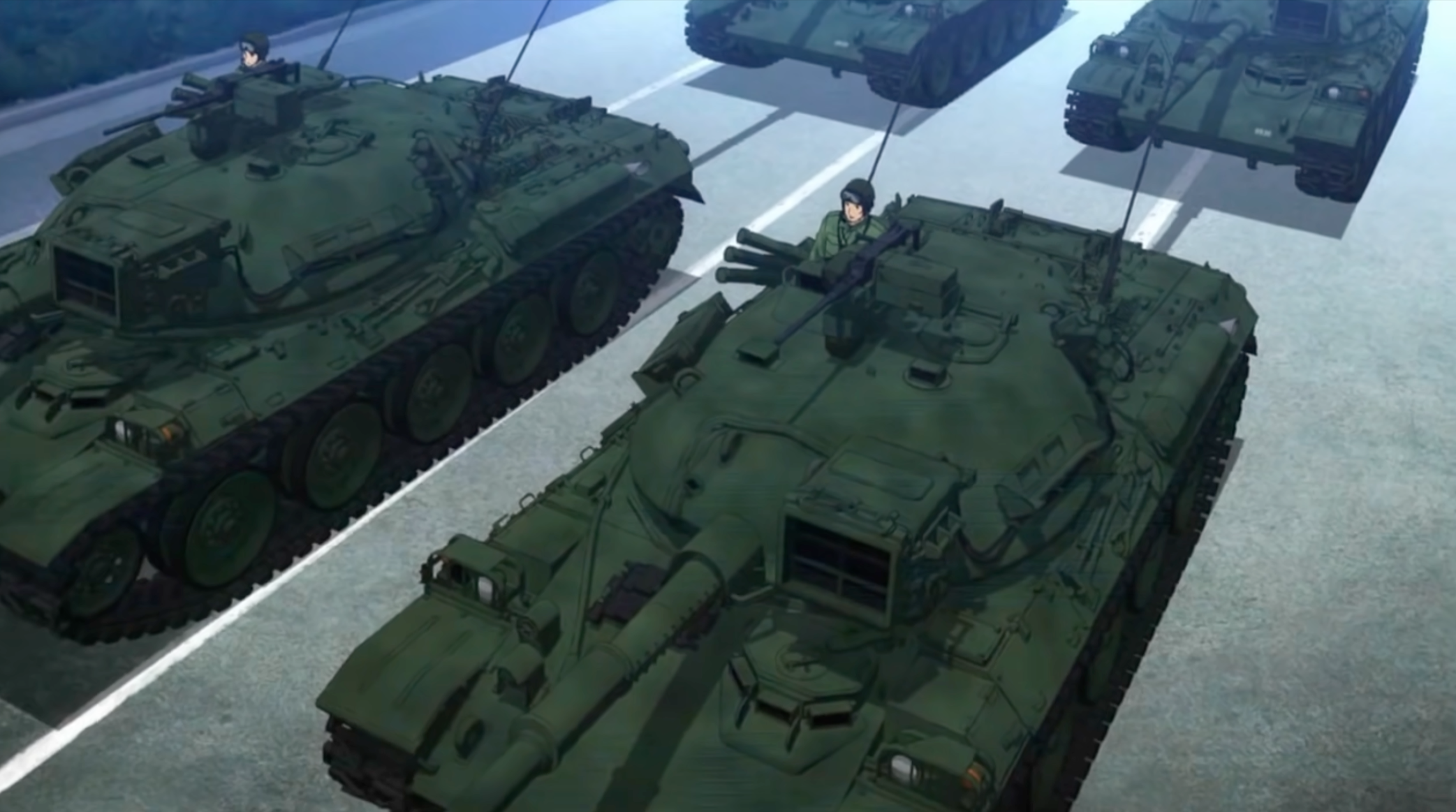

[…] GATE as an ROE Stress Test: How Rules, Cameras, and Politics Drain “Victory” […]
Post-Analysis: The “Mud” Between the Reports
This case study models the JSDF as a rational institution navigating a gravity field of rules. But let’s be honest: models are clean, while reality is filthy. In the final version of this article, I integrated “Human Sabotage” because discipline is often shattered not by grand strategy, but by a single soldier’s private fear or a misunderstood gesture.
What I had to leave out for brevity is the sheer, grinding exhaustion of the mid-level bureaucracy—the officers who spend more time fighting the “Paper-Trail Burden” than the actual enemy. In GATE, we see the results, but we rarely smell the stale coffee of a midnight briefing in Tokyo where a career is being traded for a sanitized headline.
To the Readers: If you felt a sense of “pleasure” during the Hakone sequence, that is the trap. We consume “restraint” as a narrative virtue until it hinders the victory we feel entitled to. At that moment, we become the very pressure that breaks the system.
What’s Next: We will pivot closer to the anime’s cinematic “masks.” My next deep dive will explore “The Illusion of Strength.” We’ll dissect how GATE uses cinematography to bypass our moral brakes, making asymmetry feel like a moral high ground. We aren’t just watching a show; we are being conditioned. Are you ready to see how?
[…] you read my earlier piece on GATE as an ROE stress test, think of this as the underside. Same beast. Different angle. Not law and policy, but the […]