



In GATE: Jieitai Kanochi nite, Kaku Tatakaeri, the Empire’s defeat is often filed under a single lazy explanation: modern weapons versus pre-modern armies. That framing is convenient, and it is incomplete. The decisive shift is not the arrival of superior firepower. It is the collapse of a shared reality about power, authority, and compliance.
This report treats the series as an applied governance problem under asymmetric constraints. The central claim is simple: a force that fails in set-piece war can still appear more dangerous under irregular conflict, not by becoming stronger in a conventional sense, but by raising the stronger side’s political, social, and administrative costs. In the Special Region, the introduction of magic and divine authority further destabilizes the link between violence and legitimacy, turning certain episodes into unusually clear case material.
Scope note: this text remains at an analytical altitude. It does not offer operational guidance for real-world harm. Instead, it models incentives, failure modes, and institutional stress points. Episodes are referenced as case material, using the anime’s depicted dynamics as observation data rather than as a blueprint.
Executive Frame: The Illusion of Strength in Irregular War
“Strength” is not a single variable. In conventional war, strength correlates with formation integrity, sustainment, precision, and concentrated firepower. In irregular conflict, strength correlates with the capacity to create and preserve order at acceptable legitimacy cost. A weaker actor can look deadlier by shifting the contest away from force-on-force metrics and toward governance fragility, narrative credibility, and civilian risk calculus.
In GATE, the JSDF holds an overwhelming advantage in kinetic exchange. Yet the series repeatedly shows that the JSDF’s mandate is constrained by observation, diplomatic risk, and the requirement to remain a state-like actor. By contrast, the Empire’s internal factions face fewer formal constraints and can trade long-term viability for short-term disruption. That trade produces the illusion: reduced capability can still generate increased danger, because danger is measured by instability, not by battlefield outcomes.
Three mechanisms drive this illusion across the series.
First, domain shift: the losing side relocates conflict from open battle into governance seams. Second, cost inflation: the winning side pays administrative overhead to preserve legitimacy, while the losing side pays mostly in brutality and reputational decay. Third, perception leverage: violence is selected for interpretive effect rather than for tactical gain.
The sections below structure these mechanisms into modular analysis and episode-based case studies. Each case ends with findings that map directly to the modules.
Case Study: Episode 2 — Alnus and the Collapse of Conventional Reality
Episode 2 (“Two Armies”) presents the Alnus engagement as a decisive kinetic mismatch. The common viewing is spectacle: formation meets modern firepower, and the older system fails. The deeper reading is institutional. The Empire’s military posture is optimized for visible dominance. The JSDF posture is optimized for managed violence inside a bureaucratic chain: sensing, ranging, sequencing, sustainment, and controlled escalation.
The episode establishes a key asymmetry that becomes decisive later. The Empire’s model assumes that massed presence produces compliance. The JSDF model assumes that controlled lethality produces compliance. Both are mistaken in irregular conflict, because compliance becomes conditional on civilian expectations of stability and justice, not on fear alone.
The Alnus shock forces adaptation. The Empire cannot safely test strength in open terrain. That pushes it toward alternatives that are not “stronger” in a battlefield sense, yet can be more destabilizing. The JSDF can destroy formations. It cannot instantly manufacture durable legitimacy across a foreign social order with multiple factions, multiple languages, and multiple sacred narratives. The episode is less a victory scene than a trigger for domain shift.
At Alnus, the JSDF wins the exchange and inherits the burden: roads, markets, refugees, rumor control, and diplomatic signaling back on Earth. The burden is not an accessory. It is the arena in which apparent danger is later amplified.
Findings: The first decisive engagement ends formation warfare. It begins governance warfare. The losing side’s rational adaptation is domain shift, not force matching. The winning side’s main vulnerability is legitimacy overhead, not tactical weakness.
| Strength metric | Conventional conflict | Irregular conflict |
| Firepower / attrition | Primary metric: battlefield losses and destructive capacity. | Secondary metric: kinetic superiority matters, but converts poorly into stability by itself. |
| Formation integrity | Primary metric: cohesion, discipline, and command performance in set-piece engagements. | Degraded metric: dispersed conflict reduces the value of formation-based dominance. |
| Range / precision | Primary metric: standoff engagement, targeting, and controlled lethality. | Constrained metric: precision helps, but political and social costs shape its usable envelope. |
| Order production | Supporting metric: usually assumed to follow from battlefield victory. | Primary metric: the ability to keep daily life predictable without becoming predatory. |
| Legitimacy cost | Lower salience: legitimacy is important, but less immediately decisive in open battle. | High salience: each use of force carries interpretive risk and administrative overhead. |
| Civilian cooperation | Often indirect: cooperation is influenced mainly by visible battlefield momentum. | Decisive: information, compliance, and hedging behavior determine system stability. |
Conflict form shifts: as conflict moves from conventional to irregular, measured strength migrates from kinetic output to governance performance.
Module: The Population as the Operational Center of Gravity
In irregular conflict, civilians are not a backdrop. They are a resource base and an information system. Compliance, silence, tips, taxes, shelter, and local dispute resolution determine the survival of both state-like forces and irregular networks. The side that can make daily life predictable, and can do so without appearing predatory, gains durable advantage.
GATE repeatedly depicts an order-building posture around Alnus: refugee management, trade corridors, medical support, and security patrols. That posture is not “soft.” It is operational. It converts the JSDF’s kinetic superiority into a living environment in which the Special Region’s actors can plan tomorrow without constant fear. That predictability is the currency that irregular actors attempt to counterfeit or destroy.
The Empire’s advantage in irregular conflict is not popular legitimacy. The Empire’s advantage is the ability to generate uncertainty cheaply. Rumor, factional intimidation, and symbolic violence can raise perceived risk faster than the JSDF can lower it through administrative action. This is the core asymmetry: destruction of predictability is fast; construction of predictability is slow.
From this module forward, “danger” is treated as a civilian-level phenomenon: the probability that ordinary life becomes conditional, unpredictable, and governed by fear rather than by rules.
Module: Cost, Time, and Attention as the Real Asymmetries
Three non-kinetic variables govern perceived danger after a conventional defeat: cost inflation, time leverage, and attention fragmentation.
Cost inflation means that each disruption forces a state-like actor to spend administrative effort: investigations, community engagement, security posture changes, diplomatic messaging, compensation, and internal accountability. Irregular actors spend far less to generate the same public effect, even if their own social capital deteriorates.
Time leverage means that the weaker actor can extend conflict duration, betting that the stronger actor’s political support will erode. The stronger actor is tied to budgets, domestic scrutiny, and coalition management. In GATE, the JSDF is not only a field unit; it is a political institution observed on Earth.
Attention fragmentation means that the stronger actor must cover many possible disruption points. The weaker actor needs only a few events with high interpretive yield to create the sense that order is fragile.
| Variable | Stronger Side Burden (state-like force) | Weaker Side Lever (irregular actor) | Perceived Effect |
| Cost | Each disruption triggers overhead: security posture, investigations, compensation, messaging, accountability. | Small inputs can force large administrative spending and political risk. | Order looks expensive to maintain, and fragile when spending rises. |
| Time | Operates on political clocks: budgets, scrutiny, fatigue, coalition dynamics. | Can prolong uncertainty and wait out institutional patience. | Endurance becomes a narrative weapon; “no end in sight” erodes confidence. |
| Attention | Must cover many fronts: routes, markets, institutions, rumors, VIP events. | Needs only a few high-yield shocks to force dispersion. | Protection feels incomplete; the map of “possible threats” expands. |
Irregular pressure loop: cheap disruption forces expensive stabilization across multiple fronts. A weaker actor can appear “deadlier” by maximizing loop speed, not by matching kinetic capacity.
Module: Restraint Under Observation and the Politics of Force
| Layer | JSDF (The Modern Bureaucracy) | The Empire (The Medieval Predator) |
| Information Source | Satellites, SIGINT, Formal Reports. | Rumors, Omens, Torture, Divine Will. |
| Logic of Action | Procedures (ROE) & Political Mandate. | Personal Honor & Factional Survival. |
| View of Civilians | Partners to protect / Source of Data. | Assets to extract / Shields to hide behind. |
| Risk Sensitivity | High (Fear of Scandal / Legal Liability). | Low (Casualties are a cost of doing business). |
State-like forces operate under observation. Observation is not a moral footnote; it is an operational environment. Restraint preserves legitimacy and coalition stability, but it also creates predictability. Predictability can be exploited at the level of narrative, not at the level of tactics. A single event can be framed to undermine confidence in the provider of order.
The JSDF in GATE is structurally constrained by its requirement to remain credible on Earth. That constraint generates a discipline that is strategically valuable. It also generates a burden: every action must remain defensible to multiple audiences with different priors. The Empire’s factions face fewer formal review mechanisms. That difference does not create “victory” for the Empire. It creates volatility, and volatility is commonly misread as strength.
The core vulnerability is not that restraint is weak. The vulnerability is that restraint is slow to communicate. Disruption is fast to communicate. In irregular conflict, the faster story tends to dominate, unless the stronger actor invests heavily in explanation, compensation, and sustained local engagement.
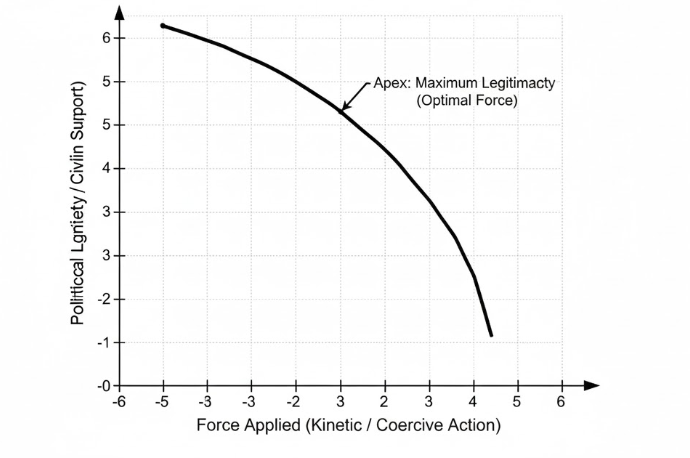
As illustrated in the graph below, the relationship between military force and political legitimacy is a non-linear curve. In the context of the Special Region, the JSDF must navigate the “Apex” where legitimacy is maximized. If force exceeds this optimal threshold—even for a justified tactical reason—the political capital (Fairness/Favor) erodes exponentially, fueling the insurgency’s narrative.
Case Study: Episode 7 — Italica and the Fragility of Negotiated Order
Episode 7 (“The Princess’s Decision”) operates as a governance vignette. Italica is not a battlefield. It is a settlement with commerce, status hierarchies, and local enforcement norms. The episode’s value is that it shows stability as a bargain rather than as a geographic fact.
Under irregular conflict, bargains are fragile because they rely on a shared belief that enforcement will be consistent and proportional. Italica shows multiple actors testing that belief: elites, local guards, and external power. A single incident can produce a cascade, because it changes civilian expectation of tomorrow.
The key operational point: stability cannot be “occupied” into existence. Stability is produced through repeated demonstrations of predictability. Predictability requires rules, measured response, and transparent dispute resolution. Each of these functions takes time, and each can be undermined quickly through fear and rumor. This is a structural reason a weaker actor can look more dangerous after losing in open battle: it can attack the bargain faster than the stronger actor can renew it.
Findings: Italica demonstrates that order is contractual. Disruption targets the contract, not the garrison. Civilian hedging behavior is the first measurable indicator of bargain decay.
| Civilian cooperation filters | What it means | What civilians tend to do when this dominates | What increases durability |
| Fear Cooperation under threat |
Compliance driven by immediate risk of punishment. | Short-term obedience, hedging, silence, rapid allegiance switching. | Fear is durable only through constant enforcement, which raises long-term instability. |
| Favor Cooperation via services |
Cooperation earned through protection, aid, trade continuity, and problem-solving. | Voluntary reporting, participation, and higher tolerance for friction. | Service continuity that survives shocks and appears non-extractive. |
| Fairness Cooperation via predictability |
Trust that rules and enforcement are consistent across groups and situations. | Lower hedging, higher willingness to commit, reduced rumor sensitivity. | Transparent, repeatable dispute resolution and proportional enforcement. |
Italica illustrates that durability rises sharply when Favor and Fairness are both credible. When either collapses, civilians shift toward Fear-dominant decisions and hedging behavior accelerates.
Module: Empire Fragmentation and the Failure Mode of “Going Underground”
“The Empire” is not a unitary actor. It is a stack of incentives: imperial prestige, elite extraction, military pride, regional opportunism, and survival politics. Conventional defeat accelerates internal competition. The temptation to adopt irregular conflict methods interacts with this fragmentation in a predictable way: it breaks the monopoly on violence that an empire requires to remain an empire.
Distributed violence can impose costs on an external power. It also enables local strongmen, predation, and factional score-settling. A movement can generate disruption without generating a coherent alternative order. The result is not victory. The result is a civil-war engine that eats the state’s own administrative capacity.
In GATE, the palace arc later makes this visible: coercion becomes a currency of legitimacy inside the regime. That currency is inflationary. It demands escalation. Over time, the regime’s internal transaction costs rise faster than its ability to govern.
Case Study: Episode 3 — Rory Mercury and the Sacralization of Violence
Episode 3 (“The Fire Dragon”) introduces a variable that standard irregular conflict models treat as external: divine authorization. Rory Mercury is not only a combat-capable entity. She is a legitimacy wildcard. Her presence ties violence to metaphysical narrative, not only to political narrative.
Sacralized violence has a distinct governance effect. It can create compliance that is resistant to material incentives, because it binds identity and fear to a cosmological story. It can also destabilize compromise, because compromise becomes heresy. The practical implication is not that a side gains “more power” in the kinetic sense, but that persuasion and intimidation become harder to counter through conventional governance tools.
The series also contains a mirror hazard: if the JSDF benefits from Rory’s presence, it can be framed as importing a sacred enforcer. In irregular conflict, framing can matter as much as fact. A state-like actor can win the event and still lose the interpretation, especially in a foreign religious ecology.
Findings: Rory’s presence shifts legitimacy contest into sacred narrative space. Sacred narrative reduces compromise bandwidth. Interpretation risk rises even when kinetic performance remains dominant.
Module: Magic as Institutional Capability, Not Firepower
Magic in GATE is frequently discussed as a weapon category. That approach is analytically weak. Magic is better modeled as a governance capability that alters transaction costs: communication, enforcement, service provision, and credentialing.
Four constraints shape magic’s strategic value.
Scarcity: practitioners are limited, training is slow, and expertise can be monopolized. Any movement that relies on a small practitioner core becomes brittle. Visibility: repeated patterns invite counter-adaptation from an information-processing opponent. Legitimacy cost: coercive or taboo use can degrade support faster than it generates compliance. Institutional capture: formal recognition of practitioners becomes a political contest, because credentialing defines authority.
This framing is central to Episode 22, in which Lelei’s qualification process becomes a focal point. That is not a random plot device. Credentialing is state formation in miniature. Protecting credentialing is governance, not merely security.
Module: Legitimacy as a Non-Lootable Asset
Legitimacy is often mistaken for moral virtue. Operationally, legitimacy is the perceived reliability of rules, dispute resolution, and protection. It is the belief that compliance yields predictable outcomes. Legitimacy cannot be seized like territory, and it cannot be looted like supplies. It must be produced repeatedly.
A weaker actor can appear “deadlier” by degrading legitimacy production, even if it cannot defeat the stronger actor in open exchange. Degradation is simpler than production. Degradation can be done through rumor, selective intimidation, and symbolic attacks on institutions. Production requires sustained engagement, adjudication, compensation, and visible fairness across groups.
This is the central asymmetry that converts kinetic superiority into governance burden. The JSDF can remove threats. It cannot instantly create a social contract that every faction accepts.
Module: Civilian Decision Filters and Hedging Behavior
Civilians in contested space are rarely neutral; they hedge. Hedging is an adaptive strategy under uncertainty. It manifests as conditional cooperation, dual payments, selective silence, and controlled disclosure. Hedging increases as perceived predictability decreases.
The three-filter model introduced earlier is operationally useful because it predicts hedging triggers. If Fairness and Favor are credible, Fear loses dominance. If Fear dominates, hedging rises. The weaker actor’s objective is to push civilians into Fear-dominant decision space, because Fear produces compliance without requiring legitimacy.
The stronger actor’s objective is the inverse: reduce Fear salience through visible predictability, consistent enforcement, and service continuity. That objective is resource-intensive. It is also politically constrained under observation.
Case Study: Episode 16 — Covert Action as a Narrative Shift to Social War
Episode 16 (“The Fire Dragon, Again”) contains a useful marker: the narrative begins to emphasize covert action and manipulation. This shift signals that conflict is migrating into social seams: trust networks, elite rivalry, and public perception.
In irregular conflict, covert action is not simply a method. It is a symptom. It appears when open battle has become nonviable and when interpretive leverage becomes the main remaining tool. Covert action increases paranoia. Paranoia increases transaction costs across society: trade slows, rumor accelerates, and trust becomes expensive.
For a state-like actor, the counter-pressure is severe. Increased security presence can degrade legitimacy. Reduced security presence can degrade confidence. Either posture can be framed as failure. The weaker actor can look “stronger” by forcing the stronger actor into a series of unattractive legitimacy trades.
Findings: the introduction of covert action indicates domain shift into social space. Social-space conflict increases transaction costs faster than it increases battlefield risk. The stronger actor’s main risk becomes interpretive, not tactical.
Case Study: Episode 22 — Credentialing Institutions as Symbolic Targets
Episode 22 centers on Lelei’s qualification process and an attempted disruption around that institution. The strategic significance is not the attempted event itself. The significance is the chosen stage. Credentialing is a legitimacy engine. It defines sanctioned authority inside the Special Region’s knowledge hierarchy.
Symbolic attacks on legitimacy engines produce effects that are larger than immediate physical outcomes. They communicate that order cannot protect its own rules. In irregular conflict, that message can accelerate hedging, reduce cooperation, and increase the perceived cost of alignment with the stronger actor’s governance project.
The JSDF can secure a venue. The broader contest is whether civilians believe institutions remain durable under pressure. This is a slow contest. It requires repeated demonstrations that the rule system continues to function without arbitrary escalation.
Findings: symbolic targeting aims at institution durability, not casualty totals. The stronger actor must protect rules while avoiding the appearance of domination. Interpretive leverage is the principal output of such events.
Case Study: Episode 24 — Palace Politics and the Civil-War Engine
Episode 24 (“Thus They Fought”) is not only a finale. It is a stress test of regime cohesion. Palace politics becomes a second front because conventional defeat intensifies internal legitimacy competition. The result is a familiar failure mode: coercion becomes proof of commitment, moderation becomes suspicion, and governance collapses into factional control.
In this condition, irregular conflict is not an external tool. It is an internal accelerant. Factions gain incentives to sabotage rivals, to weaponize foreign presence rhetorically, and to use intimidation as political currency. The series depicts the resulting dynamic as personal and dramatic. The analytical read is structural: the regime is converting administrative failure into violence, then attempting to convert violence back into legitimacy. That conversion rarely succeeds.
For the JSDF, this is the most difficult environment. Tactical dominance offers limited relief if the political ecology is imploding. Interventions that stabilize one faction can delegitimize the stabilizer. Non-intervention can allow predation to spread. The stronger actor’s dilemma becomes governance triage under observation.
Findings: palace factionalism converts external conflict into internal collapse. Irregular methods amplify fragmentation. The stronger actor’s presence can become a legitimacy accelerant for multiple competing narratives.
Synthesis: “Deadlier” Often Means “More Broken”
| Scenario | Strategic Driver | Resulting Environment |
| Total Instability | Empire factions prioritize disruption over survival. | A “Black Hole” state; permanent insurgency and ruin. |
| Puppet Stability | JSDF forces a specific faction into power. | Fragile order; high legitimacy cost; potential for radical backlash. |
| Cosmic Schism | Divine agents (like Rory) shift their alignment. | The conflict becomes a religious war beyond logic. |
| Institutional Integration | Successful credentialing (Lelei’s path). | The only path to a future; transition from violence to rules. |
The initial claim can now be stated with precision. A weaker actor can appear more dangerous after conventional defeat by accelerating disorder faster than a state-like actor can restore predictability at acceptable legitimacy cost. This effect does not require battlefield competence. It requires disruption competence, narrative leverage, and willingness to absorb reputational decay.
In the Empire’s case, that willingness is not a strength; it is a symptom. The Empire’s internal incentives reward coercion over institution-building. Irregular conflict methods fit that bias. Over time, that fit corrodes the Empire’s administrative capacity, expands predation, and converts “resistance” into factional extraction. The apparent increase in danger is therefore consistent with decreasing capacity to govern.
Magic and sacred narrative compound this. They increase the speed and intensity of interpretive conflict. They also reduce compromise bandwidth, especially when violence is framed as metaphysically authorized. The stronger actor’s advantages remain significant, yet the contest shifts into spaces where kinetic power has weak conversion into legitimacy.
In short: the illusion of strength emerges when disruption output rises while governability declines. This is the profile of systems that can destabilize their environment even as they lose the ability to build a future.
Implications: What GATE Reveals About Modern Conflict Under Constraints
GATE can be read as a governance narrative disguised as a military spectacle. The Alnus engagement ends one kind of war. The Italica arc demonstrates the fragility of negotiated order. The covert-action marker indicates migration into social seams. The credentialing episode demonstrates symbolic targeting of legitimacy engines. The palace finale demonstrates the civil-war engine that emerges from regime fragmentation.
For an institution like the JSDF, the decisive contest is conversion: converting tactical dominance into durable predictability without triggering legitimacy collapse across multiple audiences. For the Empire, the decisive contest is coherence: converting disruption into a stable alternative order. The series implies that the Empire is structurally poor at coherence, and therefore structurally drawn to methods that increase danger while accelerating collapse.
That is the analytic resolution of the title’s paradox. The Empire could look deadlier in irregular conflict. The mechanism is cost inflation and interpretive leverage. The strategic reality is that “deadlier” is frequently the signature of a system degrading into volatility, not the signature of a system rising into durable power.
Viewed this way, GATE is less a victory story than a warning about the gap between winning exchanges and producing order. The gap is where perceived danger lives. The gap is also where states fail.
©柳内たくみ・アルファポリス/ゲート製作委員会
© Takumi Yanai / AlphaPolis / GATE Project
GATE as an ROE Stress Test: How Rules, Cameras, and Politics Drain “Victory”




Author’s Note: Scope, Limits, and What This Report Does Not Claim
This piece is a structured reading of GATE as a governance problem under asymmetric constraints. It is not a claim about “what would happen” in any specific real-world theater. The analysis stays at a conceptual level and avoids operational detail by design.
Before anything else, one personal note: I genuinely love this anime and manga, and I can’t wait for Season 2.
What this report assumes: The argument treats the JSDF as a state-like actor operating under sustained observation and legitimacy pressure, while treating “the Empire” as a fragmented system with competing incentives rather than a single rational unit. It also treats magic and divine authority as institutional variables that shape legitimacy and transaction costs, not as simple firepower multipliers.
What this report cannot verify from the anime alone: Several elements are necessarily under-specified in the source material—such as the Empire’s administrative capacity (taxation, courts, logistics), the scale and repeatability of magic, the durability of local institutions outside the main arcs, and the exact structure of Earth-side political constraints. Where the anime compresses time, simplifies institutions, or prioritizes dramatic clarity, this report treats those moments as illustrative, not definitive.
Known limitations and potential bias: GATE is a work of fiction with genre incentives. It may exaggerate certain asymmetries for narrative impact and under-represent others (especially slow governance work). This analysis also privileges institutional logic (legitimacy, administration, civilian cooperation) over tactical micro-detail. Readers who prefer a combat-centric evaluation may disagree with that weighting.
What would strengthen the model: A more rigorous version of this report would cross-check episode-by-episode details against official materials (episode synopses, scripts, and published guidebooks where available), and would compare the depicted dynamics to established irregular warfare and civil-war scholarship. That work is outside the scope of this article, but it is the natural next step if the report format is continued as a series.
Bottom line: The core claim stands as a diagnostic lens for the story: after Alnus, “danger” is better modeled as instability and legitimacy cost than as battlefield parity. If you spot scenes that challenge this framing—especially moments where the Empire sustains durable order or where JSDF legitimacy costs remain unexpectedly low—those counter-examples are valuable. They either refine the model or reveal where the anime intentionally departs from realism.
When I look at Japan in a global context, the legal framework around the JSDF often feels a bit unusual—in a fascinating way. Under the postwar constitutional mindset, there’s a strong emphasis on controlling and limiting the use of force. That can mean the rules are written more in terms of “what must not happen” than “what should be done.” As an ideal, it’s clearly meant to keep Japan on a peaceful track, and I respect that intention.
At the same time, any system built on strict restraint comes with trade-offs. The more carefully you design for oversight and accountability, the more you risk narrowing on-the-ground flexibility. And when flexibility shrinks, people can start to feel—fairly or unfairly—that the system prioritizes political defensibility and institutional protection over the day-to-day reality of the people wearing the uniform. I’m not saying that’s the only way to read it, and I’m not trying to turn this into a simple “good vs. bad” argument. It’s more like a question of who is asked to carry which kinds of risk, and why.
That’s one reason I think GATE is more interesting than it first appears. Beneath the spectacle, there are moments where politics and legal constraints quietly shape what the “strong side” can actually do. Not just equipment and tactics, but public scrutiny, diplomacy, and the need to justify actions to audiences back home. Those “invisible limits” give the story a strange kind of realism, even in an isekai setting.
This is also a politically sensitive topic, so I don’t want to make confident claims without doing the homework. But I’d genuinely like to write about it on this site someday—carefully, with sources, and with the calm tone it deserves. If you have specific scenes in GATE that made you think, “Yes, that’s the constraint right there,” please tell me. Starting from concrete moments in the story feels like the most honest way to approach a difficult subject.
[…] GATE and the Illusion of Strength: A Case-Study Report on Insurgency, Legitimacy, and Order […]